

National Holocaust Centre and Museum
Shortlist – Embracing Opportunity and Harnessing Risk
Who they are
The National Holocaust Centre and Museum communicates the memory of the Holocaust for a contemporary purpose: to cultivate ‘Upstanders’ against hate and persecution. The charity considers its purpose to be urgent because, whilst time is running out to capture Holocaust survivors’ testimony, hate is on the rise. The Centre creates learning experiences that are innovative in their design and distribution, to make the Holocaust relevant for today’s and future generations.
What they’ve achieved
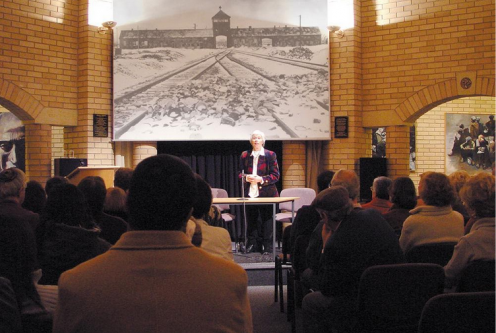
The Forever Project is an award-winning interactive experience that gives visitors a unique way to engage with the past. Using state-of-the-art natural language processing and voice recognition software, The Forever Project allows visitors to interact with a digital recording of a Holocaust survivor and then ask the survivor questions about what they lived through and why everyone should learn about the Holocaust today. The interaction is based on filmed interviews with 10 survivors, all in their 70s and 80s. On average, each survivor answered more than 1,000 questions, which were pre-recorded using ultra high definition 3-D filming techniques. When a live audience asks a question, the technology matches this with the responses, enabling the audience to more deeply engage with survivors’ testimony than would be possible with a normal film – preserving the experience of meeting a survivor of the Holocaust. The educational benefit is huge. This project preserves the experience schoolchildren currently have of interacting with a survivor and gives opportunity for the Centre to expand its reach. These interactions maximise children’s understanding of the Holocaust — and crucially, their ability to relate it to contemporary issues of hate and prejudice. The success of the Forever Project has led the Centre towards the development of a new online version, accessible away from the Centre rather than from within.
NHCM was founded in 1995 by a Christian family, the Smiths, following a visit to Yad Vashem. This brought the Smith brothers into contact with many Holocaust survivors who took the place and its aims to their hearts. From 1995 survivors had spoken daily and by 2014 NHCM was an accredited museum, unique learning centre and popular with schools. Over 20,000 pupils visited yearly and were inspired by their encounter with a survivor. But the board realised that this so-far successful model of operation had a time limited future. Trustees recognised that although dedication and commitment was still in evidence, survivors were increasingly frail. Their numbers were decreasing. They knew that to develop a lasting legacy, the future needed urgent consideration. The board brought together a steering group with experience in Holocaust education. It included board members, staff and qualified advisers. A survey was undertaken with survivors, feedback requested from visitors and third party evaluation instigated for NHCM’s educational programmes. Internationally, trustees consulted with Stephen Smith, Director of the Shoah Foundation in the US. Stephen was advancing interactive, holographic testimony and our trustees visited to investigate possibilities. Within the UK, they discussed opportunities with technology providers suggested by heritage experts. The Forever Project was the outcome of all their consultations, deliberations and planning; it represents the board’s strong vision for the future of the Centre, and their resolve to invest the necessary time and monetary resources into successful delivery.
Why they were shortlisted
The Museum recognised the need to create learning experiences, which are innovative in their design and distribution, to make the Holocaust relevant for today’s and future generations. The board evidenced great engagement when identifying the opportunity to implement an interactive experience that allows audiences not only to watch a survivor talk, but to have a question and answer session with one – ultimately meaning no loss in the museums mission whilst increasing access and engagement from young people.
The board were able to navigate the landscape of new tech successfully whilst also realising that the scope for interactive testimonies could go beyond witnesses of the Holocaust. The new project evolved into a new company that is now accessible to a wider market. Throughout the whole project, the board showed they were invested, engaged and orientated to providing a different perspective, meaning the museum can continue to deliver their mission for generations to come.
